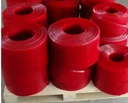
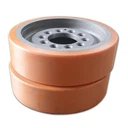
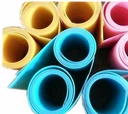
Our company was founded in 2007 and has been committed to the research and development, production, and sales of polyurethane products since its establishment. The main products produced include polyurethane wheels, polyurethane sieves, polyurethane air pipes, polyurethane boards, and other products. After nearly 20 years of development, we have a strong technical team, production team, and sales team. We have advanced pouring production equipment and testing equipment to ensure the quality requirements of each link in the production process of polyurethane treat on aluminum core wheels. You are welcome to visit the factory at any time.
Why is the processing of polyurethane tread on aluminum core wheel more "demanding"?
The main reasons lie in the material properties of aluminum and the higher precision required during manufacturing:
1.Higher thermal expansion and thermal conductivity – Aluminum has a higher coefficient of thermal expansion than cast iron and conducts heat more rapidly. During polyurethane casting (which typically occurs at elevated temperatures), if the temperature difference between the mold and the aluminum core is not tightly controlled, the aluminum core is prone to minor thermal distortion. This can lead to dimensional inaccuracies in the final product. Additionally, improper temperature management can cause trapped air or gases in the mold, resulting in bubbles within the polyurethane layer.
2.More stringent surface preparation – To achieve reliable adhesion, aluminum cores require finer and more consistent surface treatment, such as precision blasting, to create an optimal roughness for bonding. This is more critical than for cast iron, where the main focus is on removing oil, rust, and achieving general roughness.
3.Greater reliance on chemical bonding – Aluminum and polyurethane naturally form stronger chemical bonds, so the process emphasizes optimizing chemical adhesion through thorough cleaning, blasting, and the use of specialized primers or adhesives. In contrast, cast iron cores often depend on mechanical interlocking features (e.g., holes or grooves) as a backup to prevent delamination under extreme loads, making the chemical bonding requirements somewhat less critical.
4.Tighter process control – Aluminum core production demands more precise mold temperature regulation, better mold design (especially for venting), and more sophisticated heating systems to prevent both deformation and bubble formation. Cast iron cores, by comparison, are processed using more conventional equipment and techniques, with fewer special requirements.
In short, while polyurethane tread on aluminum core wheel and Cast iron core PU wheel rely on adhesion, aluminum cores demand tighter thermal and surface process control to ensure product quality and dimensional stability, making their production significantly more "finicky" than that of cast iron cores.